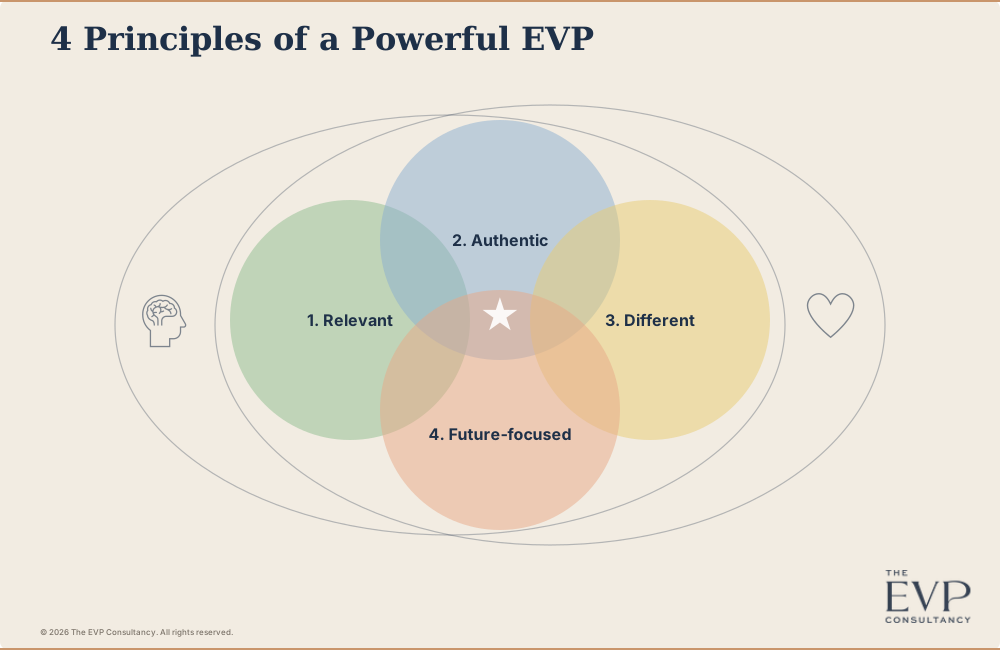
If you asked ten employer brand professionals what makes a good EVP, you’d probably get ten different answers. There’s no shortage of frameworks and methodologies out there. But after 19 years in this space, both in-house and as a consultant, I’ve kept coming back to the same four things. The EVPs that genuinely work are relevant, they’re authentic, they’re differentiated, and they’re built to evolve.
Those four principles are what I test against every time, whether I’m building an EVP from scratch or reviewing one that’s already in the market. They’re the foundation and if we get them right, the creative, the messaging, the activation all has something solid to stand on. If we miss one, it does tend to show up eventually; usually as a vague sense that the EVP exists but isn’t quite right.
Starting with the whole person
The first principle is relevance. And this one goes deeper than most people think.
The biggest point in relevance starts with a touch of neuroscience. When we understand that up to 95% of our decision-making is thought to be determined by the subconscious mind, not the conscious mind,¹ it changes our view of relevance significantly. It means that if our EVPs only speak to rational needs like salary and benefits, we’re missing most of the picture. A powerful EVP needs to land at both a rational and emotional level to be relevant. It needs to connect with how people feel about where they work, not just what they think about it.
of our decision-making is thought to be determined by the subconscious mind
Zaltman (2003)Then there’s us getting crystal clear on who we need to be relevant to. Our people aren’t a monolith. We’ve probably got operationally critical roles sitting alongside perennial hard-to-fills. Early-career talent coming through the pipeline at the same time as high-potential leaders thinking about their next move. And then there are our inclusion and representation priorities on top of that, bringing more women into finance roles for example.
The key to making sense of it and being relevant is segmentation. I know that word can feel counter-intuitive when you’re trying to build a culture of inclusion, but it’s not about dividing people; it’s about understanding that different talent segments genuinely have different needs. A graduate joining for the first time needs something different from a senior engineer considering whether to stay. The trick is finding the genuine commonalities for the overarching proposition and being clear on the differences.
Now an EVP should feel true to everyone in the organisation and it certainly shouldn’t alienate anyone. But if an EVP is going to have real impact on the business it needs to be hyper relevant to the talent segments that have the greatest strategic importance. So, before we start developing an EVP, it’s important to sit down and think about the organisation we want to build. What roles are critical for our talent pipeline? What are the roles the business genuinely couldn’t operate without on any given day? What capabilities will be mission-critical in two or three years’ time? Once we’ve mapped that, we can start to understand what each segment really needs; functionally and emotionally. The moments that matter to them, their pain points, what a good day at work actually looks like in their shoes.
A powerful EVP speaks to the whole person; but it speaks most specifically to the roles that are most critical to the future of the business. That’s what makes it relevant.
Building trust through honesty
The second principle is authenticity. And this is where a lot of EVPs can trip up.
This is because there is often a gap between what a brand promises and what people actually experience. It can start small; a slightly glossy image here, an aspiration presented as reality there. But it builds, and when it does, people start to feel a bit duped, then a little disgruntled, and slowly trust can start to erode and people start to disengage.
Consumer brands can get away with a degree of aspiration. A shampoo can promise glossier hair and imply greater confidence. But an EVP works differently. We’re not selling a product to outsiders; we’re making a promise to people who are living inside our organisations every single day and they know if it’s real or not. Some aspiration is fine; most of us want to grow with our careers and be proud of what we do, but the backbone needs to be honest about who we are, what we offer, and what working with us really involves.
Authenticity starts with how we build it. We can’t develop a powerful EVP from the top down alone. We need our actual colleagues at every level involved in the conversation.
There’s a behavioural science principle called the IKEA effect²; when people help create something, they value it more, they own it. So we involve our people in EVP development, it has a twofold impact. It helps us stay true to what they actually experience and increase the likelihood of the EVP embedding into the organisation further down the line.
Standing out when everyone sounds the same
The third principle is differentiation. And I sometimes think organisations are quietly terrified of it.
There’s an underlying anxiety that if we say what makes us genuinely different, we’ll narrow our appeal. But actually the opposite is true. Without a differentiated EVP, we’re asking talent to choose us based on something generic; great culture, brilliant people, opportunity to grow - stuff that many organisations claim. If we do that, candidates might as well flip a coin. And when push comes to shove, and a headhunter approaches our talented employees, there will be little that’s clear enough in their heads that they choose to stay. Clear differentiation, grounded in evidence is what helps us answer the question, why should someone join us specifically? And why should they stay?
And there’s a truth that can feel a little uncomfortable, even counter-intuitive; your EVP doesn’t need to appeal to everyone. If your EVP is so broad that it could attract anyone, it may well just do that. There was a time where we were getting 1 million applications a year in one organisation; that was crazy and the team were creaking under the weight of it.
Now most EVP work does look at competitors, that’s fairly standard, but what I’ve come to see with my own eyes by looking at ATS and LinkedIn data, is that our talent competitors are rarely the same as our commercial competitors. We might be competing with a tech giant for software engineers even if they’re not our business rival. We might be fighting to retain designers against boutique agencies. Understanding where we are gaining and losing talent to and from is critical to making sure we are differentiating versus the right competitive set.
With skills-based hiring breaking down traditional career paths, we’re competing for talent against more organisations than ever. A sea of sameness isn’t just uninspiring; it’s a strategic risk.
Staying relevant as everything shifts
The fourth principle is future focus. That’s because an EVP that was perfect five years ago may be way off the mark today. The world changes. Organisations change. And if our EVPs don’t move with those changes, it quickly becomes disconnected from reality.
There are two kinds of shifts worth paying attention to, I’ve found. First, societal trends that reshape what people care about. In just the last decade, we’ve watched different things take centre stage; gender in the workplace, sustainability, DEI around the time of Black Lives Matter, employee wellbeing in a post-Covid world. Those aren’t passing fads; they reflect genuine changes in what talent values and what society expects from employers.
Then there are workplace trends. The shift to hybrid working, the move toward global asynchronous collaboration through digital platforms, the arrival of AI as a tool in almost every role. These are reshaping how work actually happens, and our EVPs need to reflect what’s real today and anticipate the direction of travel, not stand still.
So, future-focused also means building in a rhythm of review. What impact is the EVP actually having? Are the right people joining? Are they staying? And when things shift, whether that’s a change in strategy internally or a shift in what the market values externally, how do we adapt? An EVP shouldn’t be a static document. It should be something we revisit, measure against reality, and evolve.
When all four work together
These four principles aren’t a checklist; they’re interconnected. An EVP can be relevant but not authentic (it speaks to what people want but doesn’t reflect what they experience). It can be differentiated but not future-focused (it stands out today but won’t in two years). The power comes from getting all four working in concert.
When we do, the EVP stops being a positioning document and becomes a genuine strategic tool. It helps us make better talent decisions, better investment decisions, and it builds the kind of trust between an organisation and its people that is genuinely hard to replicate. And that, in my experience, is where a powerful EVP starts.
Key Takeaways
- ✓Relevance means speaking to the whole person, rational and emotional, across different talent segments. If we’re only addressing what people consciously think, we’re missing most of the picture.
- ✓Authenticity means involving our people in building the EVP, not just presenting it to them. If it doesn’t pass the “would our people recognise this?” test, it needs more work.
- ✓Differentiation means answering “why us?” in a way our talent competitors can’t. If we stripped the logo off, would anyone know it was ours?
- ✓Future-focused means building an EVP that evolves; paying attention to societal and workplace trends and reviewing regularly against reality.
Thinking about your own EVP?
If you’re thinking about building or refreshing your EVP and want to talk through how these four principles apply to your organisation, that’s exactly the kind of conversation I enjoy. Feel free to get in touch.

¹ Zaltman, G. (2003). How Customers Think: Essential Insights into the Mind of the Market. Harvard Business School Press.
² Norton, M.I., Mochon, D. & Ariely, D. (2012). “The IKEA Effect: When Labor Leads to Love.” Journal of Consumer Psychology, 22(3), 453–460.