There’s a moment in almost every EVP project I work on when someone in the room goes quiet. It usually happens when I’m sharing findings from focus groups, respectfully, but also with honesty. You see what I share rarely 100% matches what they hear in their twice-yearly engagement surveys. It’s called the authenticity gap and it’s the difference between what you say about yourself and what others say about you.
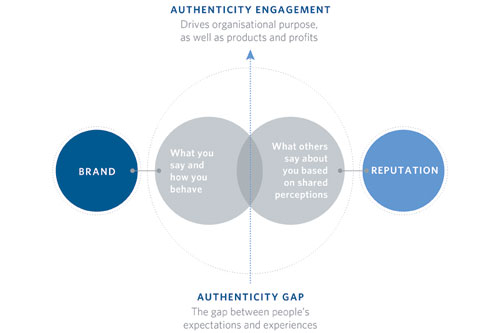
So why does this happen?
OK, so let’s start with the good news. All organisations have a gap because organisations are made up of humans who are inherently imperfect, so the gap is always going to be there. And it can happen for a number of reasons. Leaders may well have a hunch something’s not quite right, but don’t want to open a can of worms, or they simply don’t have the time to delve deeper than the pulse survey percentages. You see, I’ve spent sometimes up to 90 minutes with 10 people delving into what they think and feel about where they work and why. And depending on the organisation, me being external often creates more psychological safety than saying what you truly think and feel in your 121 with your boss.
Sometimes the EVP itself is part of the problem. It may have been built entirely aspirationally — the project team captured what the organisation wants to be and presented that as the current reality. The intent was good but it was so far into the future that it made a promise the organisation couldn’t keep. Or, the EVP was accurate when it was written, but the organisation has changed and the EVP hasn’t kept pace. Could have been a restructure, change in leadership, a merger…any which way, the culture shifted, but the messaging stayed frozen in time.
And sometimes (often), the gap isn’t at the top. It breaks down at team level, where middle managers interpret things differently, where local cultures override the corporate intent. (I’ve lost count of the number of times someone in a focus group has said “It depends on your manager” — it’s practically a universal truth.) This is the hardest gap to close because it’s inconsistent and often invisible from the top.
Ok, so, why does the gap matter?
Well, you might not realise it but the vast majority of us have experienced the same gap. Think holiday accommodation website, a restaurant menu with pics… oh and the classic — an estate agent’s glossy brochure with photos from just the right angles so you don’t see the power station from the garden.
So we can all relate. How did that feel? — let’s take the gap between the menu and the meal. Mild irritation? A little indignation that they thought you wouldn’t notice…… or that you would, but wouldn’t complain? Well, you see that’s what our employees and candidates feel, only x10. There is little emotional investment in a pub lunch. But deciding where to spend 40 hours a week is a different kettle of fish. For many of us, the place we work and what we do goes deep. We want to be able to say with pride “I work at X, Y, Z organisation” when someone asks us in the pub. It cuts into purpose, identity, belonging. So when it’s about our jobs, it goes much deeper than being ripped off for a crap burger.
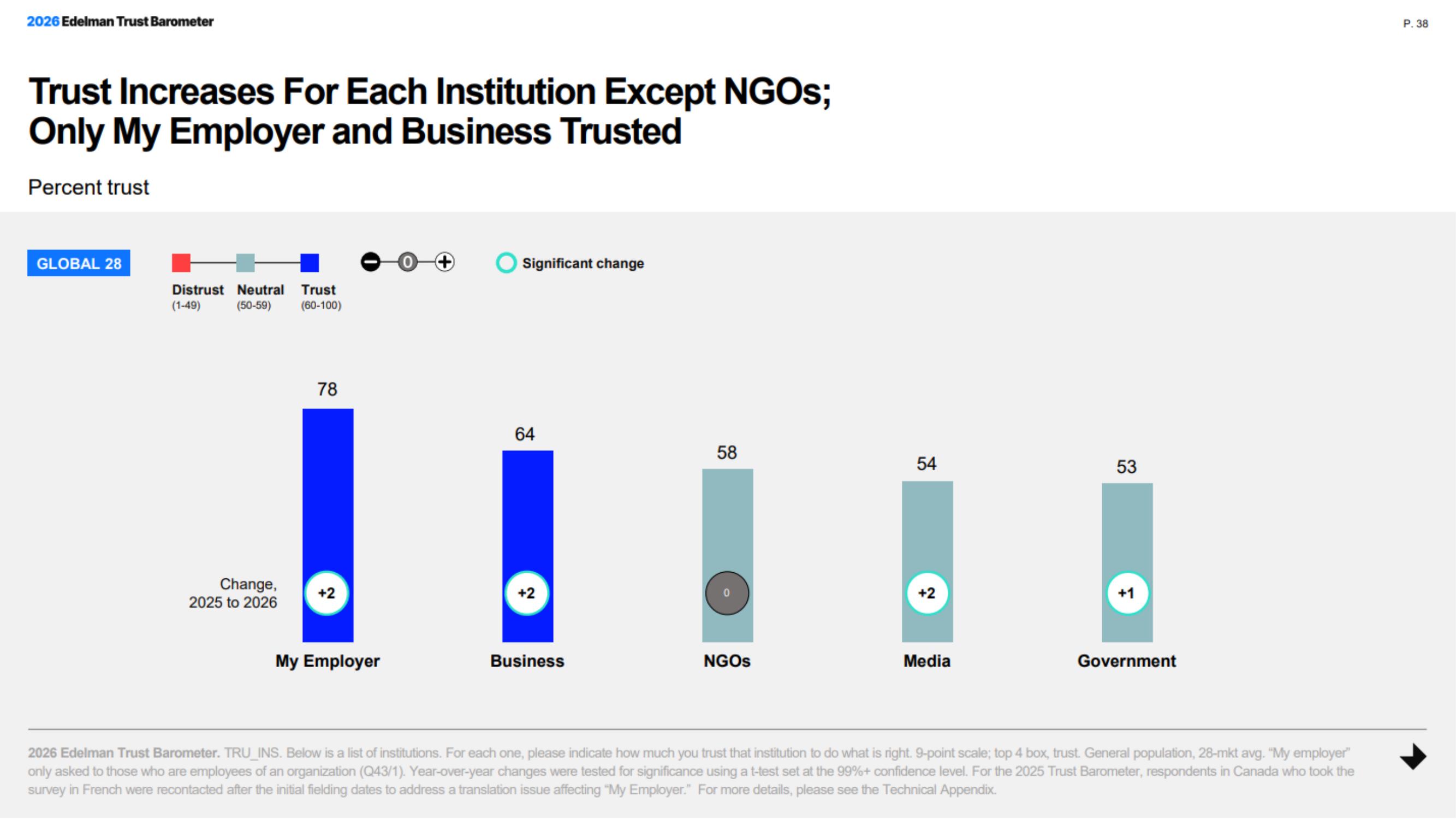
And crucially……when it comes to the gap being applied in a work context, it gets into the whole issue of trust. Edelman have been tracking trust at a global level for 26 years now and progressively over time, there have been some interesting dynamics. Over the last decade our trust in media and government have plummeted and our trust in our friends, neighbours and coworkers have risen. The world has woken up with a healthy dose of scepticism and now interestingly, the most trusted “institution” globally is, you guessed where I’m going with this… our employers. At 78%, “my employer” is the single most trusted entity Edelman tracks. So, if we do anything to damage that trust, it has an impact.
So, what impact does it have?
Well admittedly it can be small. But equally it can be huge depending on the scale of the mismatch between the promise and the reality. It might just mean a new starter begins their working life with you disgruntled, not throwing themselves in, and takes time to get productive and perform. For others, the disgruntlement is louder and they tell other people about it — either IRL or in the public domain. And some may simply decide the gap was too big and they feel so duped they just leave (especially those in roles in high demand… they have plenty of options)… and we all know the cost of early attrition.
Where the gaps typically show up
After seventeen years in this space, the gaps are consistent enough they form patterns. These are the ones I see most often:
Flexibility promised but not practised. The EVP talks about trust-based flexibility. The policy technically allows it. But the culture, driven by middle management, team norms, or unspoken expectations, doesn’t support it. People who work from home feel like they need to prove they’re working. That’s not flexibility in any meaningful sense, and people really do feel the difference, even if they can’t always name it.
Development talked about but not funded. “Growth and development” is one of the most common themes in EVP pillars because target talent usually wants it. But when the L&D budget is the first thing cut, when the mentoring programme never launched, when “development” means an annual compliance module on the LMS, that pillar loses credibility.
Values on the wall that leaders don’t model. This is sadly the one that does the most damage. If courage is a value but nobody challenges a bad decision in a leadership meeting, people learn very quickly that the real value is compliance. If collaboration is a value but promotions go to people who bulldozed through others to get something done rather than take people with them, the incentive structure tells a different story.
Wellbeing language with burnout reality. Mental health first aiders, an EAP nobody uses, a wellness week in October, a mindfulness app… (I could go on.) Meanwhile, people are routinely working evenings, weekends are expected during “busy periods” that never seem to end, and taking a genuine sick day feels like a career risk. The wellbeing offering becomes performative, and people start to resent it more than if it didn’t exist.
How to close the gap
So this is the bad news. Closing the say/do gap isn’t a comms exercise. We can’t fix a credibility problem with better messaging (although many do try)… It requires honesty, and then action.
It starts with an honest audit. Employee listening data, Glassdoor and review site analysis, candidate experience feedback, exit interview themes, sitting and listening to our people face to face. We put our EVP pillars on one side and the evidence on the other. Where do they match? Where don’t they? This isn’t about catching the organisation out, it’s about us getting clarity on where we actually stand.
What we find will usually fall into two categories. Some gaps are fixable. A policy that exists but isn’t communicated. A programme that needs funding. These are activation gaps; the intent is there, the execution isn’t. Other gaps are fundamental; the EVP says something that simply isn’t true and won’t be true any time soon — that’s smoke and mirrors territory and requires rewriting the proposition, not fixing the delivery.
The activation gaps are often more fixable than people think. Policy, process, manager capability, communication; they just need someone to own them and a timeline to deliver. This is where EVP activation and employee experience improvement become the same thing. Think of the EVP like a bobbin weaving across the strands of a loom — it’s the thread that draws the different aspects of the employee experience together into something coherent. When it’s working, you can feel the pattern. When it’s not, everything just sits there as separate threads.

The fundamental gaps need a different response. If a pillar doesn’t hold up, it’s better to take it out. An honest EVP with three strong, provable pillars is worth infinitely more than a five-pillar framework where two of them are not just slightly aspirational, but pure fiction.
And lastly, it needs to be an ongoing rhythm, not a one-off. Organisations change constantly. A regular check, annually at minimum, where we hold the EVP up against current reality and ask: is this still true? That’s how you stop the gap from re-opening.
The final good news
Here’s the thing though, trust compounds in both directions. When what you say matches what people experience, employees become advocates. Not because you asked them to, but because they want to. Candidates arrive and find that what they were told was accurate. The employer brand becomes self-reinforcing. The gap works against us when it’s left open, but it works for us when we close it.
Key Takeaways
- ✓Every employer brand has a say-do gap. The question isn’t whether ours exists; it’s how wide it is and whether we’re doing anything about it.
- ✓The biggest risk isn’t getting it wrong. It’s not knowing where the gap is, because that’s where trust quietly erodes.
- ✓Candidates are cross-referencing everything. The careers site, Glassdoor, LinkedIn, conversations with friends who work there. Any inconsistency between them is a credibility risk.
- ✓Closing the gap isn’t a communications fix. It means changing the actual experience, not just the messaging around it.
- ✓When the EVP genuinely reflects the employee experience, the EVP and employer brand becomes self-reinforcing. People advocate because it’s true, not because they’ve been asked to.
How wide is yours?
If you suspect there’s a gap between what your EVP promises and what people actually experience, you’re probably right. The question is what to do about it. If you’d like to talk it through, I’m always happy to have an honest conversation.

FleishmanHillard (2016). Authenticity Gap. fleishmanhillard.com/authenticity-gap
Barrow, S. & Ambler, T. (1996). “The employer brand.” Journal of Brand Management, 4(3).
Edelman (2026). 2026 Edelman Trust Barometer. edelman.com/trust