A borrowed idea
The EVP as a concept isn’t new, it’s borrowed. The idea of a “value proposition” first appeared in 1988, when McKinsey consultants Michael Lanning and Edward Michaels wrote about businesses as “value delivery systems.” It was a customer concept, designed to articulate what an organisation offers its customers and why they should choose it over competitors. By the mid-nineties, the idea was already being applied to people; Barrow and Ambler defined “employer brand” in 1996 as the package of benefits provided by employment, and McKinsey’s “War for Talent” research in 1997 applied the same value proposition thinking to employees. The employee value proposition was born. Same logic: understand what you offer, surface what matters, and match the two. Except this time for your own people, not your customers.
Now here’s where it gets interesting because there’s always a link between the two. It’s virtually impossible to design a customer proposition that doesn’t have employees enabling it somehow, and yet we often give little thought to the connection.
The Dragon’s Den test

Think of it like this. You wouldn’t walk into good old Dragon’s Den (or Shark Tank for some of you) asking for investment without a customer proposition. You’d get laughed out of town. But there are many organisations without an EVP at all, or, if they do have an EVP, they haven’t hardwired it into enabling the CVP.
In my head it looks like this. Our commercial strategies have our CVP at the centre of them. And our people strategies should have our EVP at the centre of them. Now, note the arrow between them; you need your people to make your commercial strategy successful; specifically people with the right skills, behaviours, and mindset, in the right quantity, to deliver your CVP.
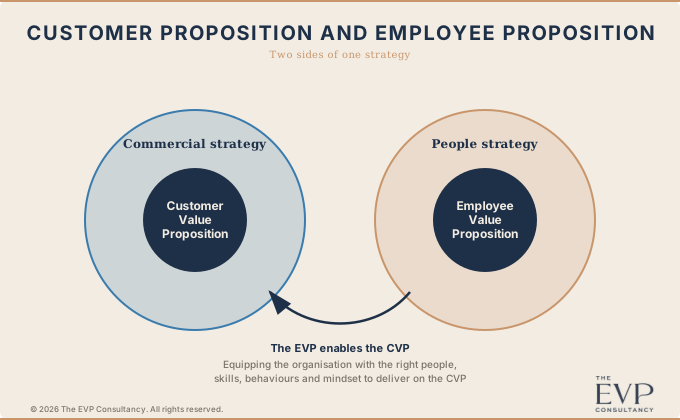
Just as a customer wants to know what you’ll do for them, a candidate wants to know what it’s like to be part of how you do it. And here’s where purpose comes in… because 9 times out of 10, the CVP and the commercial strategy are connected to the organisation’s purpose; its reason for existing beyond making money. When people buy into that purpose, they don’t just want a job; they want to know how they can be part of something bigger than just them. That’s the emotional bridge between the CVP and the EVP and one of the things that make your organisation ‘sticky’, and why the two propositions need to be in conversation with each other.
Where the disconnect usually starts
So, if the connection is important, why does it so rarely exist? In most organisations, the customer brand sits with marketing, and the employer brand sits with HR. Different reporting lines, different budgets, different agencies, neither of whom has read the other’s strategy decks. So, by the time someone notices the gap, both propositions have been signed off, launched, and the org has attempted to embed them both. And when it’s live, it’s a much harder place to start the conversation about synergy than if it had happened at the beginning.
The planning gap
And it’s not just an organisational structure problem. Many organisations are living in the short to medium term for their people strategy and the medium to long term for their customer strategy, so often no one has mapped across and thought long and hard about “what would need to be true?” to line these up.
Now clearly the commercial strategy comes first. It would be crazy for it not to… otherwise the organisation risks going bankrupt. And I know most organisations spend time thinking about the enablers and blockers of their commercial strategy. They do some great work mapping what tech, systems, and processes are needed to deliver the CVP, but somehow what is needed from the organisation’s people to enable the CVP gets missed.
What’s behind the curtain matters
And when it gets missed, here’s what happens. The customer experience doesn’t happen by magic, it’s delivered by people. And those people’s experience of working for the organisation, whether they feel trusted, equipped, clear on what’s expected, directly shapes how they show up for customers.
Think about a retailer that promises its customers a personalised shopping experience. That’s the CVP, front and centre, probably on the website, in the advertising, maybe even on the shop floor. But behind the scenes, the store teams are measured purely on transactions per hour. There’s no time built in for a conversation, no recognition for the colleague who spends twenty minutes helping someone find exactly the right thing. The customer promise says “we’ll take time for you” and the employee reality says, “you don’t have time.” That’s not a branding problem. That’s a fundamental alignment problem. The EVP and the CVP aren’t just telling different stories, they can be actively undermining each other.
But on the flipside, when they’re aligned, the result is harmony. Employees who understand the purpose and the customer promise, and feel genuinely motivated to deliver it, create better customer experiences. That improves the brand externally…which attracts better candidates…which strengthens the team. It’s a beautiful virtuous loop, but it only works at its best when the two propositions are in conversation with each other.
Building for the talent you need, not just the talent you have
So, what does it look like when you get this right from the start? This is why I’m a stickler for having strategic talent segments hardwired into the EVP development approach. At the start of the project, we sit down and talk it through. What skills do we need more of? Which types of roles? Now in theory they would be outlined in the Strategic Workforce Plan (SWP), but I have to admit after 17 years I am yet to actually see more than a couple of this fabled mystical creature in all its glory.
So my clients and I tend to do some work on the future talent they want in their organisation together. We take time to explore the skills they know they will need more of in the future to deliver the business strategy, and we build our research with an eye on what that talent wants and needs. Because not doing so means you’re only building an EVP that resonates with the talent you have today, not the talent mix you want in the future. You’re making your EVP out of date from day one.
And there’s one more piece that ties this together. Most organisations build their CVP and EVP in line with their purpose and values, which makes sense. But the bit that often gets missed is what happens after the EVP is built. If your performance management and recognition programmes aren’t aligned to the behaviours, skills, and mindset that sit at the heart of your EVP, you’ve got a disconnect. You’re telling people ‘this is what we value’ through your EVP, and then measuring and rewarding something different. When you get this right, when you’re recognising and rewarding the things that make both propositions come alive, that’s when the EVP stops being a positioning document and starts genuinely enabling the CVP. It’s the missing link, and in my experience, it’s the one that unlocks tremendous value.
Key Takeaways
- ✓Our EVP isn’t just an HR project, it’s the people-side of our commercial strategy.
- ✓The CVP and EVP are connected through purpose. When people buy into what the organisation exists to do, they want to be part of delivering it.
- ✓Build the EVP for the talent you’ll need in the future, not just the talent you have today.
- ✓The employee experience enables the customer experience. When the two propositions undermine each other, everyone feels it.
- ✓When performance management and recognition are aligned to the EVP, it stops being a positioning document and starts genuinely enabling the CVP.
Do your propositions talk to each other?
If your EVP and CVP have been built in separate rooms, it’s worth putting them side by side. If you’d like help figuring out where the connection should be, drop me a line.

Barrow, S. & Ambler, T. (1996). “The employer brand.” Journal of Brand Management, 4(3).
Lanning, M.J. & Michaels, E.G. (1988). “A business is a value delivery system.” McKinsey Staff Paper, June 1988.