If I had a pound for every time I've read a different definition of what an EVP is, I'd be a very rich lady. This is my attempt to clear things up - using the analogy I've relied on with clients for years, because I genuinely don't know a simpler or more accurate way to explain it.
It starts with a Mars Bar. Not the one in your handbag for a treat after lunch - we need to go much further back than that.
It starts with raw ingredients

Every product starts with raw ingredients. For a Mars Bar, that's the cocoa beans, sugar, milk, vanilla. Mars may well source the very best cocoa beans from Peru and the highest quality dairy, but until those ingredients are made into something, they're still just separate components sitting on a worktop.
That's like your Employee Experience. You might have the snazziest learning platform, a slick and intuitive HRIS (does that exist? I digress), and a lovely recognition programme that celebrates your very best colleagues. But until some design goes into how they work together, they're still separate raw ingredients.
Then comes the chocolate bar

Next, those raw ingredients get expertly mixed into something bigger. No wrapper yet - just the bar. And if you break one open, you can see it's made up of three things: caramel, nougat and chocolate. Three distinct components that together create a specific experience.
This is your EVP. The raw ingredients have been shaped into pillars, and together they make up your offer. And this is what people are actually buying - the experience of eating that Mars Bar, in exchange for their £1.50 (or whatever eye-watering price it is these days).
That's the give and the get. The customer gives their money and gets the bar. When employees work for your organisation, they're giving their time, skills and expertise in exchange for what you offer. Too many organisations still just talk about the raw ingredients someone gets in exchange for working there - the salary, the company car scheme, the hybrid working, the social events. And that makes it really hard to differentiate, because the raw ingredients of one employee experience look remarkably similar to the next.
Could you hand on heart say you knew it was specifically a Mars Bar when you looked at that photo of the unwrapped bar? Or would you just take a guess at "a chocolate bar... possibly a brownie or a biscuit"? That's the differentiation problem.
Then comes the wrapper

So over the years, brands developed to help with exactly that. They put wrappers on. They give the product a personality, an identity, and make it instantly recognisable. That red and gold, the font, the shape - you could spot a Mars Bar from across a petrol station.
That's your Employer Brand. The way you choose to show up to the outside world. It builds affinity, creates latent desire, and drives the kind of loyalty that has people reaching for the same bar again and again.
Then you take it to market

Here's where another common confusion creeps in, because there's also this thing called Recruitment Marketing. This is the supermarket shelf. It's where Mars wants more of its chocolate to sell than the other brands - competing for that prime eye-level position.
Our equivalent of a supermarket shelf is a job board. Recruitment marketing is what you do when you actually have vacancies to fill and you're competing against other organisations looking to attract the same software engineer or delivery driver. Your employer brand is working all the time, building that perception and connection. But it's only when you have vacancies and you're trying to sell your jobs that you put them on the shelf.
And finally - reputation

The very last part is your Employer Reputation. Your employer brand is what you say about yourself. Your reputation is what other people say about you. It's what newspapers write about when you make redundancies. It's what your employees write on Glassdoor. It's the conversations that happen in networks you'll never see.
And here's the thing - even Mars knows the wrapper matters less than people think. In 2023, they swapped their iconic plastic wrapper for paper. Same bar. Same caramel, nougat and chocolate. Completely different wrapper. And nobody stopped buying Mars Bars - because the product inside hadn't changed. That tells you everything about where the real value sits.
The wrapper gets all the attention
Now here's the problem. Most organisations spend the bulk of their employer brand budget on the wrapper. Careers site redesigns. Recruitment marketing campaigns. Glassdoor management. Social content calendars. Branded merchandise for university fairs. All of which matters - visibility matters, consistency matters, first impressions matter.
But if someone buys a Mars Bar because the wrapper looks great and then bites into it and finds there's no caramel, they're not coming back. Worse than that - they'll tell people. The wrapper created an expectation that the contents didn't deliver on. Classic style over substance.
This is exactly what happens when organisations invest heavily in employer brand without doing the deeper work on their EVP. The external presence looks polished, the messaging is consistent, the careers site is beautiful - and then someone joins and finds that what they experience doesn't match what they were shown. The wrapper was great, but the contents were a let-down.
The blindfold taste test
Remember the Pepsi vs Coke blind taste tests? The whole point was to strip away the branding and find out whether the product itself was distinctive enough to be recognised on its own merits.
Here's the equivalent for your organisation. If you blindfolded someone - stripped away the careers site, the LinkedIn content, the recruitment marketing, all the wrapper - could they still identify what makes working here different? Could your employees describe the experience in a way that's recognisably yours?
The only reason most people could pick a Mars Bar in a blindfold test is because the taste - that specific combination of caramel, nougat and chocolate working in harmony - matches what they want. It's distinctive, it delivers, and they want to enjoy it over and over again (to the dismay of their waistlines!).
That's what a strong EVP does. It makes the experience so distinctive and so aligned with what the right people are looking for that they keep choosing you - not because of the wrapper, but because of what's inside it.
So I hope that helps - and I haven't made you all too hungry.
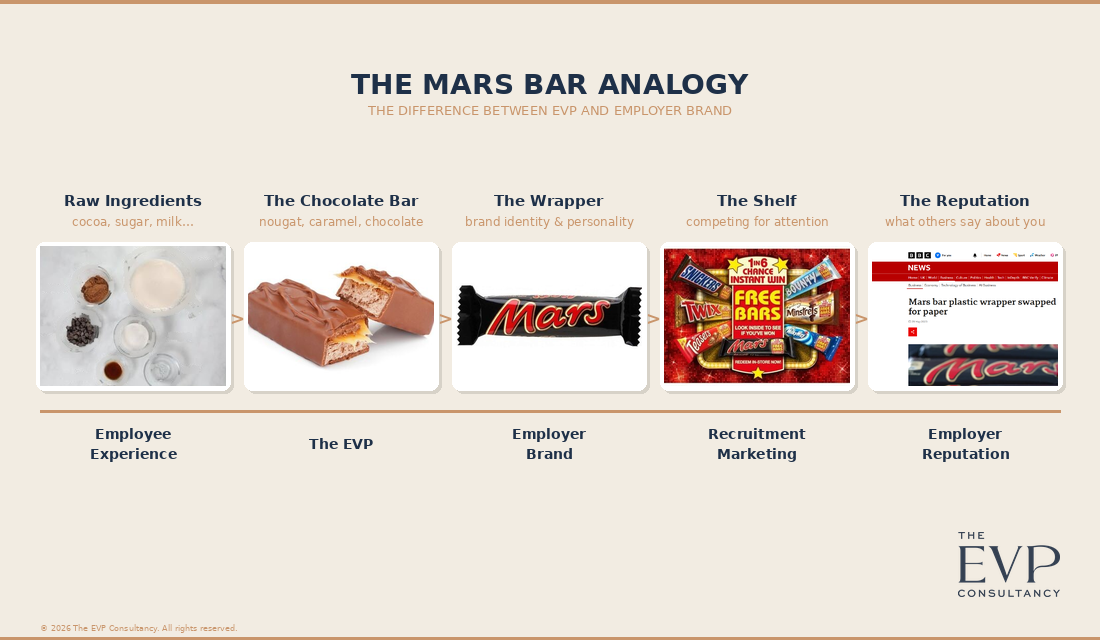
Employer brand is how people recognise you. EVP is what they actually experience. Recruitment marketing is how you compete for attention. And reputation is what others say when you're not in the room. The most effective organisations work on all of them - but they start with the substance, not the packaging.

The Mars Bar Analogy is an original framework developed by Vicki Saunders / The EVP Consultancy. © 2026 The EVP Consultancy. All rights reserved.